
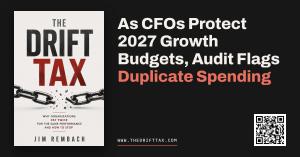
Jim Rembach's The Drift Tax gives CFOs a 24-month audit that finds training and other people spending that buys the same performance twice.
From Chapter 6 of The Drift Tax by Jim Rembach.
Susan Fowler, Founder/CEO of Mojo Moments Inc, on The Drift Tax.
The Drift Tax by Jim Rembach, an Amazon Best Seller in two Business & Management categories.
Jim Rembach, author of The Drift Tax.
Jim Rembach's Amazon Best Seller The Drift Tax gives CFOs a 24-month audit that finds training and other people spending that buys the same performance twice.
Repurchase is what the broken chain looks like on a budget.”
— Jim Rembach, Executive Director, Leadership Execution Institute
GREENSBORO, NC, UNITED STATES, November 24, 2026 /EINPresswire.com/ -- Only 43 percent of CFOs expect organic revenue growth above 5 percent in 2027, down from 67 percent a year earlier, according to a Gartner survey of 150 finance leaders released November 11. Gartner analyst Vaughan Archer said the challenge will be "to protect the investments most likely to drive future growth." The Drift Tax: Why Organizations Pay Twice for the Same Performance and How to Stop gives finance leaders an audit aimed at one kind of duplicate spending that no ledger labels as such. Training, coaching, consultants, and engagement programs that buy back performance the company already funded through pay or earlier programs are booked as new investment. The audit sorts the last 24 months of those lines with one question: "Was this a first purchase, or a repurchase?"
Author Jim Rembach, Executive Director of the Leadership Execution Institute, calls the exercise the Repurchase Audit. It closes the sixth chapter, "Paying Twice: The Repurchase Pattern," which opens with an executive team deciding, in the book's words, "what next year's money believes." LEI Press published the book on October 12, 2026. Two days later Amazon named it a Best Seller in two Management & Leadership categories.
Why does the book treat two different budgets as one purchase?
The book's November planning meeting approves two requests within one hour. The first renews an engagement initiative whose survey gains faded after its first year. The second funds a premium development program for directors ahead of the company's most ambitious strategic push in a decade. One was filed as repair and the other as growth. "The accounting treats them differently. The behavior layer does not," Rembach writes. Both budgets pay for what the book calls information events, gatherings where knowledge is delivered and evaluated before people go back to a workplace that has not changed. Neither contains a dollar for the Tuesday after the event ends.
The book's directors come back with frameworks that show up in their meetings for two or three weeks. After that the ordinary calendar resumes, and each director slides back to the behavior the environment held before the program. "The growth budget did not buy growth. It bought temporary access to growth behaviors," Rembach writes.
What do program evaluations measure?
The book gives evaluations credit for the event itself. "First comes the evaluation, and the evaluation is glowing," Rembach writes, adding that good providers are good at the event. A real, measurable bump follows. Then comes the decay. Evaluations and completion figures were built to confirm that a program took place and that people valued it, Rembach notes. Whether the behavior still holds a year later is a different question, one those instruments were not designed to answer. In his account, that is how a repair program earns its next year: "each one produced a bump, and a bump is evidence, and evidence earns renewal."
Why doesn't the annual budget process catch it?
The book cites McKinsey research finding that companies that outperform shift 10 to 20 percent of capital year over year toward higher-return uses, while traditional budgets lock capital into allocations based largely on last year's choices. People budgets do move, according to Rembach. "It moves money from last year's initiative to this year's relaunch of last year's initiative: same depth, same layer, new vocabulary."
Part of the reason is where the lines sit. Compensation, the original purchase, lives in one budget category. Programs, the repurchase, live in another, reviewed by different people in a different meeting. The book ties this to the Kinetic Chain of Execution, its model of how strategy becomes daily behavior. When drift weakens the transfer between links, results downstream stop matching what was funded upstream, and the organization spends again to restore the missing force. "Repurchase is what the broken chain looks like on a budget," Rembach writes.
Does company size change the pattern?
The book points to General Electric's Predix platform, launched in 2013 to make GE "a top 10 software company." Roughly six years and a reported four billion dollars later, a new chief executive called a two-month timeout to fix the program. Post-mortems cited in the book found uneven adoption across business units, a sales force that struggled to sell the product, and customers who did not change how they worked. "Scale doesn't eliminate the pattern; it simply makes the levies larger," Rembach writes.
How does the Repurchase Audit work?
The audit reaches past training to every people-related line, including retention incentives and replacement hiring. In the book's definitions, a first purchase is capability the organization had never funded before, such as a new skill for a new market. A repurchase is capability already funded through compensation, culture, or prior programs and bought again because it decayed.
Rembach adds two cautions. Relaunches count, because "phase two" of a repair, he writes, "is a repurchase wearing a lanyard." The sorting belongs with the CFO rather than a committee, "because committees will defend their lines and the value of this exercise is in the undefended total." He describes the ratio that comes out of it as "the closest thing to a Drift Tax assessment they will ever hold."
"The Drift Tax puts a price on a cost I have spent my career explaining: motivation is not additive. External rewards can buy behavior for a moment, but fulfilling people's psychological needs for autonomy, competence, and relatedness determines whether that behavior holds when real pressure hits. Jim Rembach has taken what motivation science has shown for decades and built the organizational case most leaders have never seen," said Susan Fowler, Founder/CEO of Mojo Moments Inc, and author of Why Motivating People Doesn't Work . . . and What Does.
What can a budget team check before renewals are signed?
The book's Drift Tax Diagnostic includes a dimension called Ownership and Accounting. It asks whether anyone owns the behavioral layer and whether the company knows its ratio of first purchases to repurchases. The free online version at diagnostic.thedrifttax.com takes a few minutes and returns an Architecture Score out of 100, with an Exposure Report naming the lowest-scoring dimension. Finance and HR leaders can take it separately and set the two readings side by side.
Hardcover, paperback, ebook, and audiobook editions of The Drift Tax are sold through Amazon and major retailers. Excerpts are at www.thedrifttax.com.
About The Drift Tax
The Drift Tax: Why Organizations Pay Twice for the Same Performance and How to Stop, by Jim Rembach, is published by LEI Press and was released October 12, 2026, in hardcover (ISBN 979-8-90589-141-0), paperback (ISBN 979-8-90589-140-3), ebook (ISBN 979-8-90589-139-7), and audiobook (ISBN 979-8-90589-142-7). It is about the hidden taxes organizations pay when their people drift, causing execution failures, and how to stop paying them. www.thedrifttax.com
About Jim Rembach
Jim Rembach is the Executive Director of the Leadership Execution Institute and President of Execution Architects, where he helps organizations design and implement the scaffolding needed to upgrade their operating systems for the post-AI era. He is the author of The Drift Tax and the host of the Fast Leader Show, where he has interviewed hundreds of the world's most influential management thinkers. He spent three decades inside complex operations before writing the book. He lives in Greensboro, North Carolina.
About LEI Press and the Leadership Execution Institute
LEI Press is the publishing division of the Leadership Execution Institute, an independent research organization studying leadership behavior, behavioral drift, and culture-calibrated execution systems in modern organizations. The institute's research briefs, reports, and publications are available at leadershipexecutioninstitute.org.
Review copies and interviews are available on request.
Emma Allen
Leadership Execution Institute
+1 3362021032
press@leadershipexecutioninstitute.org
Visit us on social media:
LinkedIn
YouTube
Legal Disclaimer:
EIN Presswire provides this news content "as is" without warranty of any kind. We do not accept any responsibility or liability for the accuracy, content, images, videos, licenses, completeness, legality, or reliability of the information contained in this article. If you have any complaints or copyright issues related to this article, kindly contact the author above.
