


The Hidden P&L Line: Why Employee Financial Stress Is a CFO Problem
Every CFO can quote the cost of their office lease, their software stack, and their cost of capital to the basis point. Far fewer can tell you what employee financial stress is costing the company — even though, for many organizations, it is a larger and faster-growing expense than items that actually appear on the P&L.
It stays invisible because it hides inside other numbers: lost productivity, absenteeism, turnover, errors, and healthcare claims. But the driver behind it is easy to see, and it is getting worse. U.S. household debt reached a record $18.79 trillion in the first quarter of 2026 (Federal Reserve Bank of New York), and 59% of Americans say they could not cover a $1,000 emergency without borrowing (Bankrate, 2026). The average household carrying a credit card balance owes $10,895 at an average rate of 21.52% (NerdWallet; Federal Reserve). Your employees are not exempt from those figures — they are those figures.
The cost is quantifiable
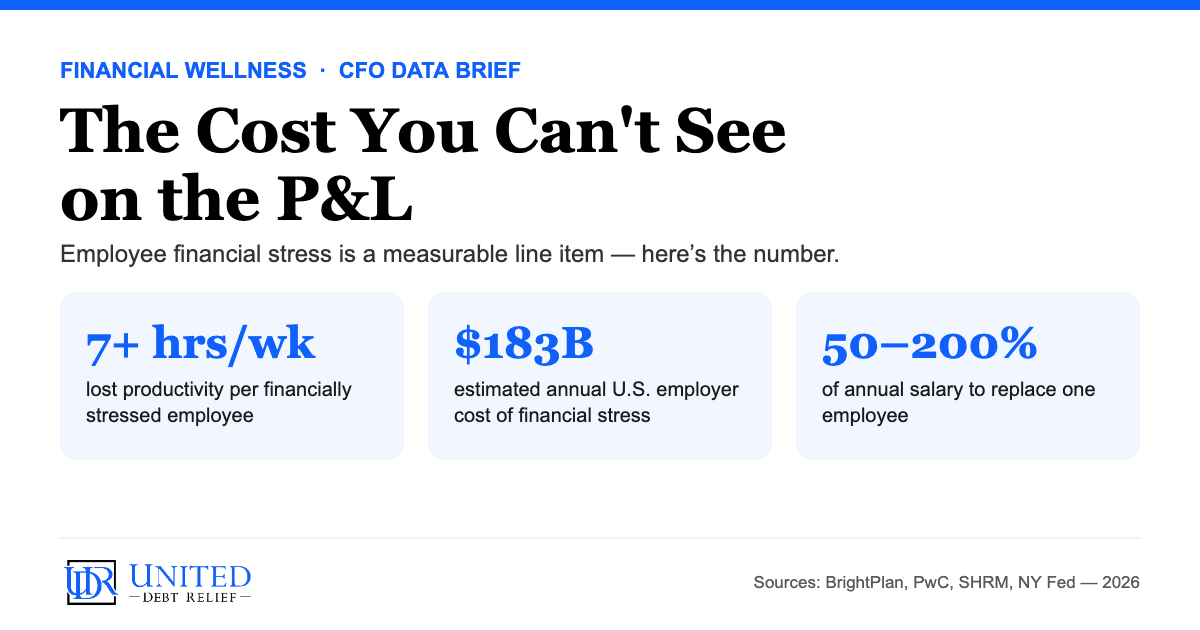
This is where it stops being an HR talking point and becomes a finance problem. Employees lose more than seven hours of productivity per week to financial stress, costing U.S. employers an estimated $183 billion a year, according to BrightPlan’s Wellness Barometer Survey. PwC’s Employee Financial Wellness Survey sharpens the picture: 56% of employees spend three or more hours each week dealing with personal financial issues while on the clock, and financially stressed workers are four times more likely to be distracted at work.
Run that through your own payroll. If even a tenth of your workforce is losing several focused hours a week, you are already funding the problem — just through diminished output instead of a line item you can see and manage.
It is a retention and risk issue, too
The cost does not end at lost hours. Financially stressed employees are roughly twice as likely to be hunting for a new job, and 78% of organizational leaders say employee financial stress drove higher turnover in the past year (SHRM). That matters because turnover is one of the few hidden costs finance teams can actually price: replacing an employee runs 50% to 200% of their annual salary, depending on role and industry (SHRM).
There is a risk-management dimension as well. A distracted, distressed employee makes more errors. In roles that touch cash, controls, or sensitive data, acute financial pressure is a recognized risk factor — one worth assessing the same way you would treat any other operational exposure.
Why this lands on the CFO’s desk
Financial wellness has long been filed under “HR perk” — a line in the benefits brochure. That framing is exactly why it has been underfunded and under-measured. Reframed correctly, it is an investment with a calculable return: you spend to reclaim productive hours and reduce turnover, both of which you can quantify.
CFOs are well positioned to lead here precisely because the case is financial, not sentimental. The discipline you would apply to any capital allocation works cleanly:
- Baseline the cost. Pull your real turnover rate and replacement costs, healthcare trend, and whatever data you have on absenteeism and benefits utilization. That is your current spend on the problem, whether you have named it or not.
- Pilot deliberately. Treat a financial-wellness or financial-coaching benefit the way you would treat any pilot — defined scope, defined metrics, a clear kill criterion.
- Measure against KPIs you already track. Retention, time-to-productivity, absenteeism, benefits engagement. If reclaimed hours and reduced turnover do not clear program cost, you end it. If they do — and the cost data suggests they often will — you scale it.
The overhang is not going away
Consumer debt at 21.52% APR does not resolve on its own, and the macro picture is not improving quickly. The companies that treat workforce financial health as a strategic, measured investment — not a feel-good benefit — will carry a quieter advantage into the next few years: lower turnover, fewer distracted hours, and a steadier workforce, while competitors keep absorbing the same costs without naming them.
The number is already in your financials. The only question is whether you are managing it deliberately or paying for it by default.