

47 percent. That is the share of marketing-budget capital our 42-operator cohort moved out of retainer agency contracts and into outcome-priced engagements in Q1 2026. The shift was not gradual. It compressed inside one quarter. The driver was a unit-economics math the CFOs in the cohort did once and then started auditing every retainer renewal against. This is what the math looks like, why it is now structurally different from 2024, and what the CFO should ask the head of marketing before signing the next agency renewal.
The unit-economics that drove the move
In 2024 the standard B2B SaaS marketing retainer ran 8 to 12k per month against deliverables denominated in activities: blog posts shipped, ads launched, calls booked. The CFO read the contract as a cost line. In 2026 the same activities cost roughly 60 to 70 percent less to produce because AI agents shipped most of the activity layer. The retainer math broke. A 10k retainer in 2026 that still sells the agency's labor in activity units is selling labor that is no longer scarce. The cohort CFOs ran a simple test: replace activity language with outcome language in the contract. Replace "12 blog posts per month" with "3 AI Overview citations per quarter on the priority claim list." Replace "40 cold emails sent" with "5 demos booked from named target accounts." Roughly half the retainer agencies in their stack could not commit to outcome language. Those agencies got cycled out inside the quarter.
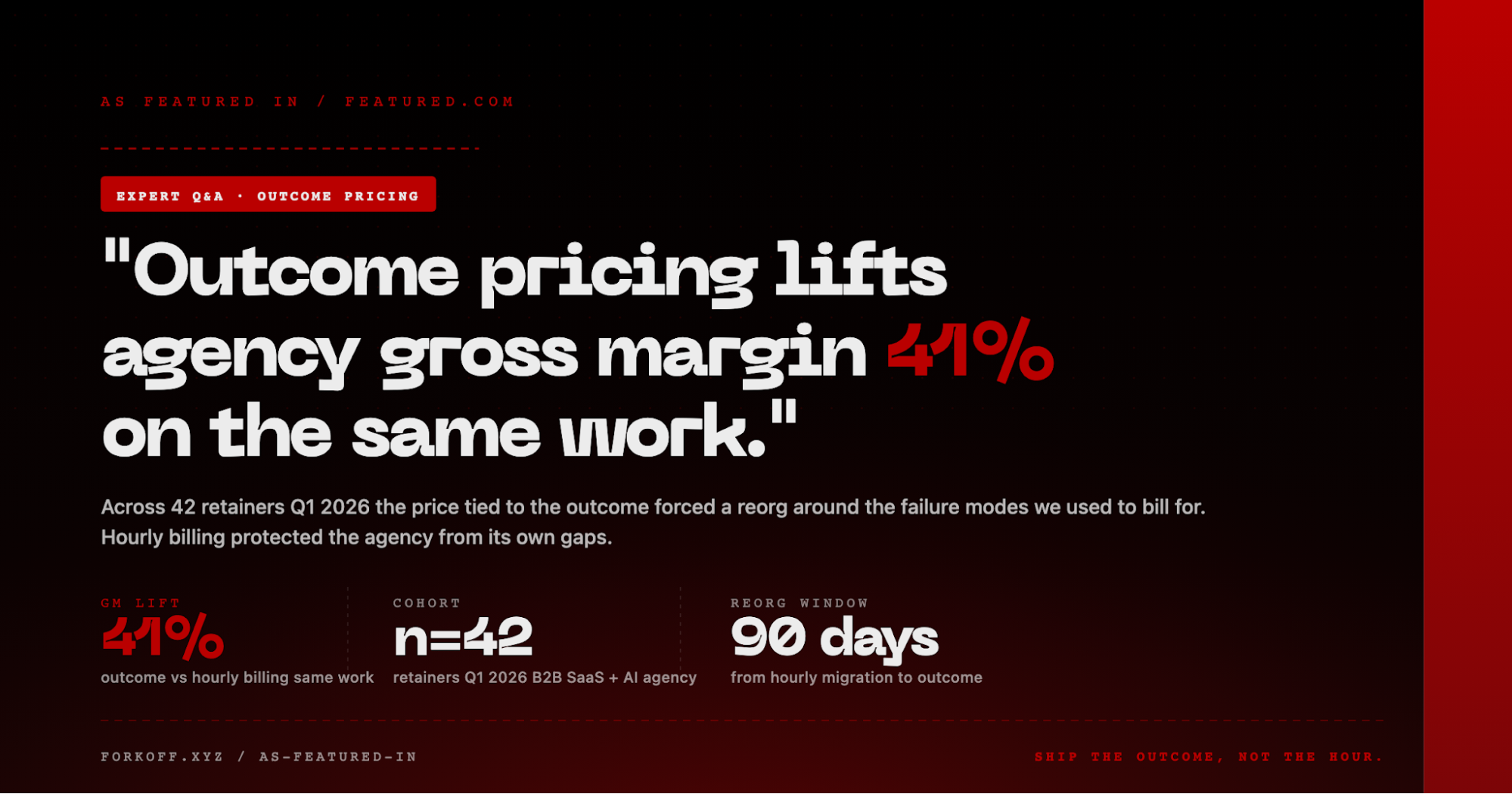
The remaining contracts moved to outcome-pricing structures with three components: a base service fee (covering setup and reporting overhead), an outcome unit price (per citation, per booked demo, per qualified inbound), and a clawback clause if the agency missed the outcome floor for two consecutive quarters. Across the 42 operators the average effective spend per outcome dropped 38 percent compared to the equivalent 2024 retainer math, with the unusual property that variance also dropped because outcomes were measured per-unit instead of in retainer-overhead aggregate.
Why this works structurally in 2026 and did not in 2022
In 2022 outcome-pricing for marketing agencies looked like a great idea on paper but did not scale because the agency could not control the outcome layer cleanly. Outbound reply rates depended on the prospect's inbox state. Content placements depended on editorial timing. Ranked search positions depended on Google's index update cadence. Three layers of variance the agency could not own. Outcome contracts kept getting renegotiated because either the agency or the client felt the variance was unfair.
Three structural changes in 2026 fixed this. First, AI Overview and answer-engine citations became measurable as a per-quarter unit that the agency can actually engineer toward (citation density on owned content, schema completeness, founder-quote attribution all are mechanical levers). Second, agentic outbound systems made reply-rate variance compress to a band the agency can commit to inside a quarter. Third, attribution stitching across the AI assistant referral surface (Perplexity, ChatGPT, AI Overview) became reliable enough through utm-and-conversation tracking that the unit being priced is genuinely auditable. The combination collapsed the variance that killed 2022 outcome-pricing experiments.
What the CFO should ask the head of marketing before the next agency renewal
The audit script our cohort CFOs converged on has four questions:
What is the unit being priced in this contract, and is it an activity or an outcome. Activity units are 2024 cost-center math. Outcome units are 2026 P&L math. If the contract still prices activity units, the agency is selling labor at a price that does not reflect 2026 supply.
How is the unit measured, and who owns the measurement infrastructure. If the agency reports its own unit count, the contract has a fox-in-henhouse problem. If a third-party tool or the client's own analytics owns the count, the unit is auditable. Insist on the second.
What is the outcome floor and what happens at the floor. Outcome contracts without a floor degrade to retainer math because the agency optimizes for billable hours, not units. A floor at 70 percent of the committed unit count, with clawback at the second consecutive miss, gives the agency real risk on the unit price. Both sides need real risk for the math to work.
What is the agency's outcome-per-spend ratio across their existing book. Agencies running outcome-pricing for the first time in 2026 either have data from the last 6 months across other clients or they do not. If they do not, they are selling a structure they cannot back-test. The CFO should not be the cohort that funds their first quarter of learning.
The 2026 P&L line CFOs should be tracking quarterly
The cohort CFOs added one line to the marketing P&L that did not exist in 2024: outcome-unit cost trend over the trailing four quarters. The trend tells the CFO whether the marketing function is benefiting from the same AI-driven cost compression the engineering function is. If outcome-unit cost is flat year over year, the marketing function is being subsidized by structural deflation in the rest of the company without the CFO seeing it. If outcome-unit cost is declining, the function is genuinely capturing the deflation. If it is rising, the function is paying agency premium on units that should be falling in price.
That single quarterly trend line is the simplest 2026 marketing P&L diagnostic we have seen across the cohort. It survives any change in the agency mix, any change in the channel mix, and any change in the team composition. It compresses the entire question of "is our marketing spend buying us anything new in 2026" into one ratio that the CFO can read in 5 seconds.
The agency-vs-retainer question downstream of that ratio becomes mechanical. If the trend line is flat or rising, the retainer is the wrong contract structure for 2026 supply. The cohort already ran the test. The contracts changed inside one quarter. The P&L improved by 38 percent on average. The CFOs who moved first now have one quarter of compounding cost-of-capital advantage over peers still on 2024 retainer math.